
The Secrets of Parchment: Exploring Research and Craftsmanship through the Ġilduża Project
Overview
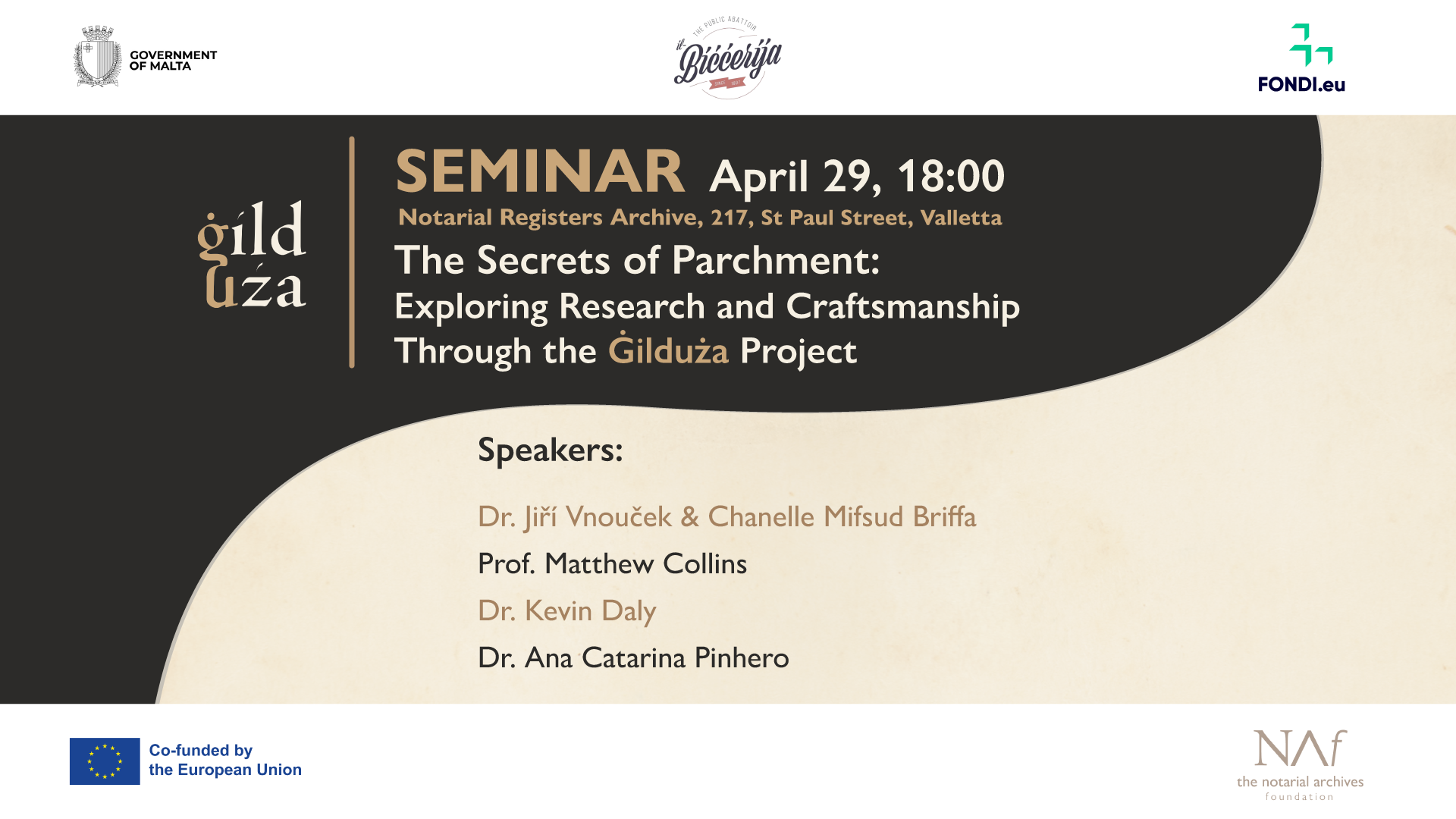
Title: The Secrets of Parchment: Exploring Research and Craftsmanship through the Ġilduża Project
Date & Time: Wednesday, 29 April, 2026 | 18:00
Location: Notarial Registers Archive, 217, St Paul Street, Valletta
Bringing together leading experts, the seminar will examine parchment from multiple perspectives, from traditional craftsmanship to scientific research. At the centre of the seminar is Ġilduża, a project working towards the revival of parchment-making in Malta through collaboration between artisans, conservators, historians, scientists, and farmers. Ġilduża, co-funded by the European Union under the European Agricultural Fund for Rural Development (EAFRD), is a collaborative project between the Notarial Archives Foundation, the Malta Public Abattoir, and Dr Jiří Vnouček.
Programme and Speakers
18:00
Welcoming addresses and introductions
18:40
Parchment making in Malta: towards a revival: The Ġilduża project bringing together artisans, conservators, historians, scientists, and farmers
Dr Jiří Vnouček, Senior Researcher, The Royal Library Copenhagen
& Chanelle Mifsud Briffa, Head of Conservation, Notarial Archives Foundation
Abstract
This project brings Malta’s traditional craft of parchment-making back to life, exploring its history, techniques, and cultural significance. In the process, a new training centre is being set up to pass on this knowledge through hands-on learning. This project brings together participants from various fields.
The initiative uses locally sourced animal skins that would otherwise go to waste, promoting a sustainable approach to craft and supporting local communities. Collaboration between multiple institutions ensures the revival is socially, culturally, and ecologically responsible.
Looking ahead, the project also aims to incorporate the study of Maltese livestock genetics to help understand historical parchment production, distinguish local from imported skins, and fill gaps in knowledge of Malta’s material history.
Bio-notes
Jiří Vnouček studied conservation in Prague. In 1992/93 he was an intern with Christopher Clarkson at West Dean College, England. In 2010 he obtained a Master’s degree in conservation in Copenhagen, Denmark. In 2019 he completed his doctorate at the University of York (Centre of Medieval Studies and the Department of Archaeology) in England. From 1984 to 1991 he was a paper and book conservator at the Strahov Library in Prague and from 1993 to 2005 head of the Conservation Department at the National Library of the Czech Republic. He has been employed at the Royal Danish Library as a conservator since 2005 and as a senior researcher since 2024. His research combines methods of visual assessment of parchment in medieval manuscripts with experience from his own experimental parchment making and manuscript conservation. He regularly organizes workshops, lectures and publishes articles on these topics. From 2019 to 2024 he participated in the ERC research project Beast to Craft and from January 2025 he is a member of the research team of the ERC project Insular Manuscripts in the Age of Charlemagne.
Chanelle Mifsud Briffa is Head of Conservation at the Notarial Archives Foundation. In 2020, she was awarded a warrant as a book and paper conservator by the Bord tal-Warrant tar-Restawraturi. She is currently a PhD candidate at the University of Malta, where her research focuses on the discolouration of 18th-century documents through non-invasive analytical techniques.
19:10
Parchment: Layers of Meaning – The Biomolecular Adventure Hidden in Every Document
Prof. Matthew Collins, Professor of Palaeoproteomics at the University of Cambridge and Professor of Bioarchaeology at the GLOBE Institute, University of Copenhagen
Abstract
Before any word was written, a document had a biography. The parchment on which a notary’s hand moved was once a living animal whose skin was soaked in lime, stretched on a frame, and scraped to translucency. For centuries, scholars have read what is written on these pages. We can now read what is written in them.
Every sheet of parchment is simultaneously a legal record, a biological archive, a chemical time capsule, and an environmental diary. Using techniques drawn from ancient DNA analysis, protein fingerprinting, and stable isotope chemistry, we can now recover the species and geographic origin of the animal, the season in which it was slaughtered, the diseases it carried, the climate it lived through, and the hands that handled the finished document across generations of use.
Bio-note
Matthew Collins is Professor of Palaeoproteomics at the University of Cambridge and Professor of Bioarchaeology at the GLOBE Institute, University of Copenhagen. Together with Sarah Fiddyment, he developed the non-destructive electrostatic extraction technique that allows protein and DNA recovery from medieval manuscripts without damaging the object, enabling investigation of parchment production, species identification, and the use of exotic materials in bindings. He co-developed ZooMS (Zooarchaeology by Mass Spectrometry), now widely used in heritage science. He is a co-investigator on the CODICUM ERC Synergy Grant, an interdisciplinary project applying biomolecular methods to Nordic manuscript fragments. He is a Fellow of the British Academy, the Royal Danish Academy of Sciences and Letters, and the Royal Swedish Academy of Sciences, and a recipient of the Pomerance Award for Scientific Contributions to Archaeology.
19:35
Pox in the parchment: What can we learn about ancient animal diseases from parchment
Dr Kevin Daly, Assistant Professor at UCD School of Agriculture and Food Science, University College Dublin
Abstract
In addition to their use in manuscripts, parchments represent the preserved tissue of animals that may have lived over a thousand years ago. DNA preserved in these materials can recover information about the animal itself, as well as the pathogens that may have affected them.
This presentation will describe the recovery of the sheeppox virus from medieval European parchments made from a range of species. From 21 ancient virus genomes, spanning from the Bronze Age to Early Modern Europe and recovered from both parchment and skeletal remains, we learn how this highly lethal animal disease evolved alongside human civilisation.
These findings demonstrate how animal diseases have shaped human history, and how parchment represents a rich biological archive of our past.
Bio-note
Kevin Daly is an Assistant Professor at the UCD School of Agriculture and Food Science, University College Dublin. A trained geneticist, Dr Daly’s research has focused on the domestication of small ruminants (sheep and goats). From March 2026, he will lead the European Research Council-funded project “HERDPATH”, exploring how livestock and pathogens have coevolved since the beginning of livestock keeping.
20:00
Metagenomics and the Study of Parchment Purple Spot Damage
Dr Ana Catarina Pinheiro, Senior Technician, Biology, Analytical Laboratory, José de Figueiredo Laboratory
Abstract
Parchment biodeterioration, particularly the formation of purple spots associated with collagen fibre degradation, remains an important challenge in manuscript conservation. This study reviews recent advances in the field and presents metagenomic data obtained from medieval codices with different preservation conditions.
DNA extracted from samples collected from a heavily affected manuscript and from a comparatively well-preserved codex was analysed through Illumina sequencing targeting the 16S rRNA V3–V4 region for bacteria and ITS markers for fungi. The results support the currently proposed microbial succession model, in which halophilic microorganisms introduced during brining are followed by environmental bacteria and fungi.
The predominance of Actinomycetota, Firmicutes and Proteobacteria in the analysed samples is consistent with later stages of this process and reinforces the relevance of manufacture and use-related contamination in the biodeterioration of parchment.
These findings confirm the value of metagenomics for investigating parchment degradation while also underlining the need for broader comparative studies and refined methodologies.
Bio-note
Catarina Pinheiro is a pharmacist and conservator-restorer with a PhD in Conservation Science. Her research has focused on microbiology applied to cultural heritage, with work carried out at the University of Coimbra, NOVA University Lisbon, and the University of Évora. She currently works at the José de Figueiredo Laboratory (Museus e Monumentos de Portugal), Lisbon, where she is responsible for biological analysis and co-coordinates integrated pest management across a network of 37 museum institutions in Portugal.
20:30
Concluding Remarks
20:40
Drinks & Nibbles
Registration
Free entrance. Seating is limited. Registration now open .
Other useful information:
There is no need to print tickets once order is confirmed.
Seating is limited. Once the event starts, all unoccupied seating will be given to walk-ins. We encourage you to be on time as seat availability is on a first-come, first-served basis.
The seminar will be photographed and filmed for documentation, and use in media and reporting.
The lift is currently unavailable. Access through staircase only (2 floors).